

Did you know?
The market size of global contrast injectors is estimated to reach USD 1.9 billion by 2025!
Growth of the contrast injectors market is the result of several factors such as:
- Growing prevalence of cancer and CVD
- A large number of approvals for contrast agents
- Increasing investments, funds, and grants by government organizations
- With such fast growth and demand for these medical devices worldwide, the future of contrast injectors looks promising. Let’s gain more insight into them.
What are Contrast Injectors?
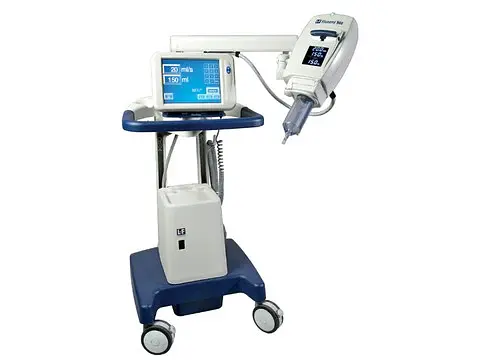
Contrast injectors are medical devices that are employed to inject radio-opaque contrast media into the body. This enhances the visibility of tissues for a medical imaging procedure. As these inject contrast media into the body, they are also known as contrast media injectors.
Auto injectors are the automated versions. Another version is known as CT injector, which is used to inject computed tomography (CT) iodine-based contrast agents.
These injectors can inject contrast media for different imaging procedures. For instance, the auto injector can be used for CT (computed tomography) and angiographic procedures.
Driving Forces for Contrast Injectors
As mentioned above, cancer and CVD cases are on the rise. According to the WHO World Cancer Report, it is estimated that cancer patients might increase by 50% to 15 million by 2020! Strokes and CVDs are also proving to be the major causes of deaths all over the world, as per the World Health Organization (WHO).
In 2015, the WHO estimate represented 31% (approximately 17.7 million) of deaths globally by CVDs. This count is estimated to increase to 23.6 million by 2030.
Such grave situations need more accurate tests, results, with safety of patients. Here, contrast media injectors come into play. As these are injected at the time of diagnostic imaging, image quality as well as patient safety is improved.
Therefore, as the number of cancer and CVD cases increase the demand for superior healthcare facilities and highly developed diagnostic imaging procedures is stimulated. This will result in a big boost for contrast injectors’ requirement.
Contrast Media Injectors Have IT- Enabled Solutions
Now, contrast media injectors are LCD screen enabled. This not only maintains flow rates but also monitors the status of the patient. Another promising technology for this medical device is the introduction of new software that is capable of generating data in real-time.
This software allows easy and quick access to information that includes injection pressure, type of contrast media, contrast media flow rate, and injection speed. The software can be directly connected between the hospital’s IT department and its hospital information systems or electronic medical records. Thereby, the injector provides access to patient data from picture archiving and communication systems.
The contrast injector software reduces the error rate, time, and effort to upload statistical data and images manually. So, the overall process and action taken for treatment is enhanced.
The Streamlined Segmentation of Contrast Media Injectors
For the convenience and enhanced efficiency, the market of contrast media injectors is segmented into varied sections. These segments are discussed below -
a. Segmentation based on the product
The market of contrast media injectors is segmented into consumables, accessories, and injector systems. During the forecast period, the consumables segment is expected to witness the highest growth rate.
In this segment, the growing requirement of consumables for maintaining safety and hygienic conditions during diagnostic procedures is responsible for high growth rate.
b. Segmentation based on application
Segmented into radiology, interventional radiology, and interventional cardiology; the contrast media injectors are driving the growth of these applications. A major factor for this can be the use of contrast media in radiology procedures.
c. Segmentation based on end-user
The contrast media injectors are segmented into hospitals and diagnostic imaging centers. The latter has the second largest market share for contrast media injectors. Increase in the number of private imaging centers plays an instrumental role in the growth of diagnostic imaging centers. The demand for early diagnosis and diagnostic imaging along with the lack of imaging modalities in small and mid-scale hospitals is constantly on the rise. This highlights the promising potential of contrast media injectors.
Growth of Contrast Media Injectors in Asia Pacific
The Asia Pacific is expected to register the highest growth of contrast injections. Geographically, the contrast media injectors are segmented for function in North America, Europe, Asia Pacific (APAC), and the other parts of the world.
Asia Pacific region is anticipated to grow at the highest CAGR. It is because of factors such as growing investment in radiology in India, rising aging population and cancer incidence in Japan, the rising R&D investments and favorable demographic scenario in China, and increasing government support to reinforce healthcare service delivery in other countries.
Challenges for Contrast Media Injectors
With so much to have encouraging factors and growth of the contract injections, factors that stand as challenging blocks here are –
Lack of skilled professionals - Handling advanced and refined diagnostic imaging systems needs a high level of technical proficiency. The shortage of specialists and radiologists is another vital challenge across the continents.
High cost – Contrast media injectors, consumables, and accessories cost pretty high. It varies with the type of injectors (single-head, dual-head, and syringe less) preferred by hospitals.
For instance, a Pedestal Mount CT Injector costs USD 40,600 and a Ceiling Mount for Long CT Injector costs around USD 45,000.
ACIST CVi Injectors for Cath Labs, the prices are going to increase well over the 6 figure dollar range.
The cost of consumables is recurring as the same tube and syringe cannot be reused because of hygiene and safety issues.
All these factors cause a major setback for end users, as tubes and syringes cost USD 350–500 each. Thus, escalating the cost of using contrast media injector systems.
In a nutshell, contrast media injectors have a bright future as these media devices have a long way to go for diagnosis that lead to timely and more accurate treatment procedures for serious diseases. Though, few challenges are there but with the course of time and technological advancements these will also be solved.


