

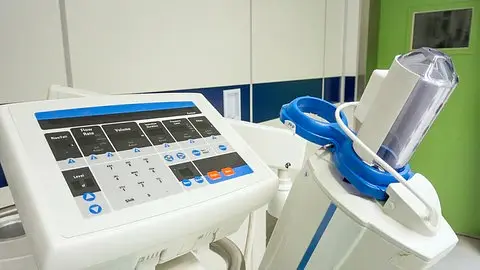
Contrast injectors are medical devices used in radiology to inject contrast agents into a patient's body during diagnostic imaging procedures. Contrast agents are substances that help to enhance the visibility of internal organs and tissues on imaging scans such as CT scans, MRI scans, and angiograms.
Contrast injectors are designed to deliver the contrast agent into the patient's bloodstream at a controlled rate and with a specific amount of pressure, ensuring that the contrast agent is evenly distributed throughout the body. This helps to produce clear and detailed images that can be used to identify a wide range of medical conditions.
There are several types of contrast injectors available, including power injectors, dual-head injectors, and syringe injectors. Each type of injector has its own advantages and disadvantages, and the choice of injector will depend on the specific imaging procedure being performed and the patient's individual needs.
These medical instruments have progressed from basic manual injectors to fully automated systems that not only accurately manage the quantity of contrast media agents utilized but also allow for automatic data collecting and personalized dosages for each individual patient, thanks to technological improvements.
According to Strategic Market Research, the worldwide contrast media injectors market grew at a 7.5% CAGR, reaching $2.15 billion in 2021, and is expected to reach $6.68 billion by 2030. Growing cancer and CVD cases worldwide, increased government expenditures, money, grants, and many contrast agent approvals are just a few of the drivers driving market development.
HOW AND WHY DO CONTRAST INJECTORS PLAY SUCH AN IMPORTANT ROLE IN HEALTHCARE?
Contrast injectors are vital in diagnostic imaging because they allow healthcare providers to get high-quality pictures, which are required for proper diagnosis and treatment of a variety of medical disorders. Here are examples of how contrast injectors improve diagnostic imaging quality:
Enhancing image contrast:
Contrast agents aid in the improvement of contrast between various tissues and organs, making it simpler for healthcare practitioners to distinguish between well-functioning and sick tissues thus assisting them to make the right diagnosis. Contrast chemicals also improve blood vessel visibility, making it simpler to detect blockages or other abnormalities.
Reduces scan times:
Contrast injectors supply contrast agents with a regular rate and pressure, ensuring that the contrast agent is spread equally throughout the body. Therefore, imaging findings are more consistent and trustworthy, minimizing the need for repeated scans and saving time. They also provide contrast chemicals in a timely and efficient manner, minimizing the time required to perform imaging operations. This is especially vital for time-sensitive imaging methods employed in emergency care.
Reducing the possibility of adverse reactions:
Contrast injectors can give a specific dose of contrast agent according to the patient's body weight and medical history, lowering the danger of under or over-dosing. This reduces the possibility of adverse effects such as contrast-induced nephropathy. They also assist in reducing the danger of contrast extravasation, which happens when the contrast agent seeps into the surrounding tissues and causes discomfort, edema, and tissue damage.
UPCOMING CONTRAST INJECTORS TRENDS TO LOOK OUT FOR:
Compatibility with imaging software:
Contrast injectors are increasingly being connected with imaging software, allowing healthcare providers to manage the injector and monitor contrast agent distribution in real-time. This integration has the potential to increase the imaging method's precision as well as security.
Wireless connectivity:
Contrast injectors are increasingly being fitted with wireless connectivity, enabling them to be managed remotely and giving healthcare providers with real-time data analysis. This can aid in increasing efficiency and reducing the need for manual modifications during imaging processes.
Enhanced safety features:
Improved security functions, including automated air removal and pressure monitoring capabilities, are being developed for contrast injectors. These elements can assist in reducing the likelihood of adverse events occurring during imaging operations.
FINAL THOUGHTS:
Contrast injectors are anticipated to continue to play an essential part in diagnostic imaging operations as technology advances and new applications are discovered, thereby increasing the accuracy and safety of medical imaging. These technologies are likely to become even more effective, cost-effective, and safe as research and development continue and as AI becomes more and more involved, leading to better outcomes for patients and a more promising future for diagnostic imaging. If you are on the lookout for high-grade contrast injectors, contact PT MEDICAL TECHNOLOGIES, your one real source for all types of purchasing, selling, or trading of the most recent medical equipment, including contrast injectors.


